
System design
On-Grid, Off-Grid or Hybrid? Choosing the Right Solar System Type for Your Business
The three common configurations behave very differently. They connect to the grid differently, they treat your night-time load differently, and they change what you pay and what you save.
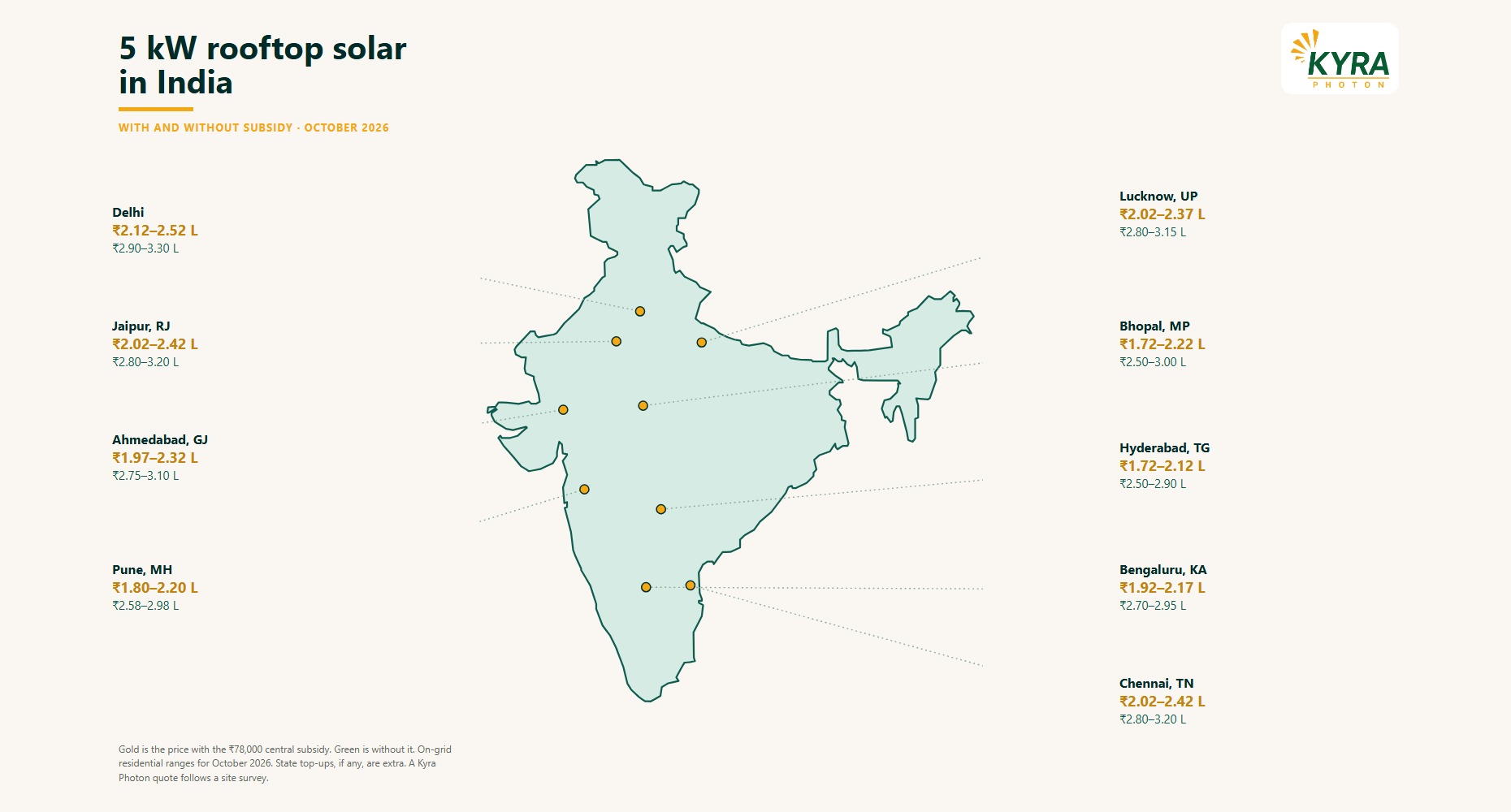 5 kW rooftop solar prices across India in October 2026. Gold is with the central subsidy. Green is without it.
Most solar conversations start with size and price. For a business, there is an earlier question that shapes both: what type of system are you actually building?
The three common configurations behave very differently. They connect to the grid differently, they treat your night-time load differently, and they change what you pay and what you save.
The short version
| On-grid | Hybrid | Off-grid | |
|---|---|---|---|
| Grid connection | Yes | Yes | No |
| Battery storage | No | Yes | Yes |
| Works during a grid outage | Generally no, by design | Yes, for the loads it is wired to back up | Yes |
| Complexity | Lowest | Higher | Highest |
| Typical business fit | Plants with strong daytime load and a reliable grid | Sites that cannot afford downtime or face frequent outages | Remote sites with no usable grid connection |
On-grid: solar working alongside the grid
An on-grid plant feeds your site's electrical system in parallel with the utility supply. When the sun is up, your machines draw from the panels first and the grid fills the gap. When it is night or cloudy, the grid carries the load as usual.
Why businesses choose it:
- No batteries to buy, house or replace
- Simpler design, and fewer components that can fail
- Savings come from the units you no longer buy from the grid
What to know: By design, grid-connected inverters switch off when the grid goes down, as a safety measure for utility workers. Unless the system is built for backup, an outage stops the plant along with the grid.
Where it fits best: Plants that run mostly in daylight, such as single-shift and two-shift units, where most of what solar generates is used on site.
Hybrid: solar, grid and storage together
A hybrid system adds batteries and a controller that decides, moment by moment, whether power comes from the panels, the batteries or the grid.
Why businesses choose it:
- Critical loads keep running through outages
- Stored energy can cover part of the evening or peak-time demand
- Useful where outages are frequent or downtime is costly
What to know: Batteries add cost, space, cooling and maintenance, and have a finite life. The question is not whether a hybrid system is better, but whether the value of backup and shifting energy justifies those costs for your load.
Where it fits best: Sites with sensitive processes, cold storage or healthcare loads, or locations where grid reliability is a real problem.
Off-grid: independent of the utility
An off-grid system has no utility connection. Panels, batteries and often a backup generator carry the entire load.
What to know: It must be sized for your worst day, not your average day, and it needs more storage than any other design. For plants with a grid connection available, it is rarely the economical choice.
Where it fits best: Remote locations where bringing a grid connection is impractical.
What this means for a factory
A few points are specific to industrial and commercial sites:
- Three-phase supply: Most industrial plants run on three-phase power, so the inverters and protection must match your supply configuration.
- Load matching: Solar produces in daylight. What decides your savings is how much of that output your plant uses at the time it is generated. A plant that runs mostly at night needs a very different design from one that peaks at midday. The method for that capacity is in how big a solar plant your factory needs.
- Connection rules: Metering and grid-connection requirements differ by consumer category and utility, and they are revised from time to time. Your design must follow the rules in force when you apply.
- Surplus power: What happens to generation your plant does not use depends on those same rules, so it should be understood before you size the plant.
Which one is right for you? Ask these questions
- How much of my consumption falls in daylight hours? The higher the daytime share, the stronger the case for a plain grid-connected plant.
- How reliable is my grid supply, and what does an outage cost me? The more expensive downtime is, the more backup is worth.
- Which loads are critical? Backing up an entire plant is very different from backing up a control room or a cold chain.
- What space do I have? Batteries need room, ventilation and safe access.
- What is my commercial model? CAPEX, RESCO/OPEX and Open Access each shape the choice differently.
How the commercial model interacts with system type
- CAPEX: You fund the plant, so every extra component, including batteries, is your cost and your risk. Design for the return on your capital.
- RESCO / OPEX: You pay for the power you consume, so the provider's design choices show up in the per-unit rate you are quoted.
- Open Access: Renewable energy is delivered to your plant from a project beyond your premises, so the question of on-site storage often becomes a question of how you manage delivery against your load.
What it looks like in practice
Our rooftop plants include Polyspin Exports Limited at 1.3 MWp and Chola Packaging at 959 kWp in Rajapalayam, and Artika Cotton Mills (Ramraj) at 821 kWp in Erode. For larger requirements we have built ground-mount plants such as the Suvarrchit Renewable Energy 13 MWp project in Tiruvannamalai and the Koochur Solar Park 7.8 MWp in Krishnagiri. In each case the design followed the customer's load and site, not a standard template.
How Kyra decides
We begin with an Energy Study of your bills and load profile and a Site Survey of your roof or land. Then comes Engineering, where the configuration is chosen and modelled, followed by Approvals, Installation, Commissioning, Monitoring and Maintenance, all managed by one team.
Since 2013, Kyra Photon has delivered end-to-end renewable energy solutions for commercial and industrial businesses, with 400+ projects commissioned across India.
Not sure which configuration suits your plant?
Share your electricity bills and site details, and our engineers will study your load and recommend a design that fits how your plant actually runs. Call 044-3531-1888.
FAQs
Can a solar plant run my factory during a power cut?
A plain grid-connected plant generally cannot, because its inverters shut down when the grid fails. Backup requires a design that includes storage or another source.
Is hybrid always better than on-grid?
No. It adds cost and maintenance. It is better only where the value of backup or energy shifting outweighs those costs.
Do I need batteries to use solar at night?
Only if you want solar-generated energy at night. Without storage, the grid supplies your night-time load.
Is off-grid suitable for an industrial unit with a grid connection?
Rarely. It requires large storage and is usually chosen only where the grid is unavailable.
Does my supply type affect the design?
Yes. Inverters and protection must suit your supply configuration, which is checked during the site survey.
Let's Build a Sustainable Future, Together.
This article is for general information only. Tariffs, tax treatment, regulations and technology specifications change over time and vary by project and consumer category, so please refer to current official sources and your advisors before making decisions. Project figures are as published by Kyra Photon.