Tracking controller
Calculates the appropriate panel position using a programmed solar-position algorithm, sensors, or a combination of control methods.

Our Services
From design and permitting to commissioning and monitoring — engineered for commercial and industrial performance.
View all services →Commercial ground-mounted solar
Improve solar energy capture with a single axis solar tracker designed to follow the sun's movement throughout the day. For businesses planning ground-mounted solar installations in Chennai and across Tamil Nadu, solar tracking technology can help increase energy generation potential and improve the utilization of a suitable project site.
Kyra Photon Tech can be your starting point for discussing solar technology requirements and evaluating the right solution for your project. Whether you are planning an industrial solar installation or exploring a large-scale solar project, understanding tracker performance, installation requirements, and long-term costs is essential before making an investment.
Planning a commercial solar project? Contact Kyra Photon Tech to discuss your requirements and explore suitable solar solutions.
Unlike a fixed tilt, the panels turn on one axis as the sun moves from east to west. Whether that is the right investment in Chennai depends on the land, the solar resource, the structure, the electricity demand, and the project economics. Kyra Photon Tech has engineered solar projects since 2013 and has commissioned more than 400 systems, so the comparison can start from the site in front of you.
Get a Free Quote
Share the site, the planned capacity, and the land so we can discuss a tracker.
One axis, through the day
A Single Axis Solar Tracker system is a mechanical mounting arrangement that rotates solar panels around one axis to follow the sun's apparent movement across the sky. Unlike fixed-tilt solar installations, which maintain a constant panel angle, a tracking system adjusts panel orientation throughout the day.
This movement helps solar modules receive sunlight at more favourable angles during different periods. Single-axis trackers are commonly considered for utility-scale solar farms and suitable commercial and industrial ground-mounted installations.
For businesses evaluating a single-axis solar tracker in India, the decision should consider the site's solar resource, land availability, structural requirements, electricity demand, and expected project economics.
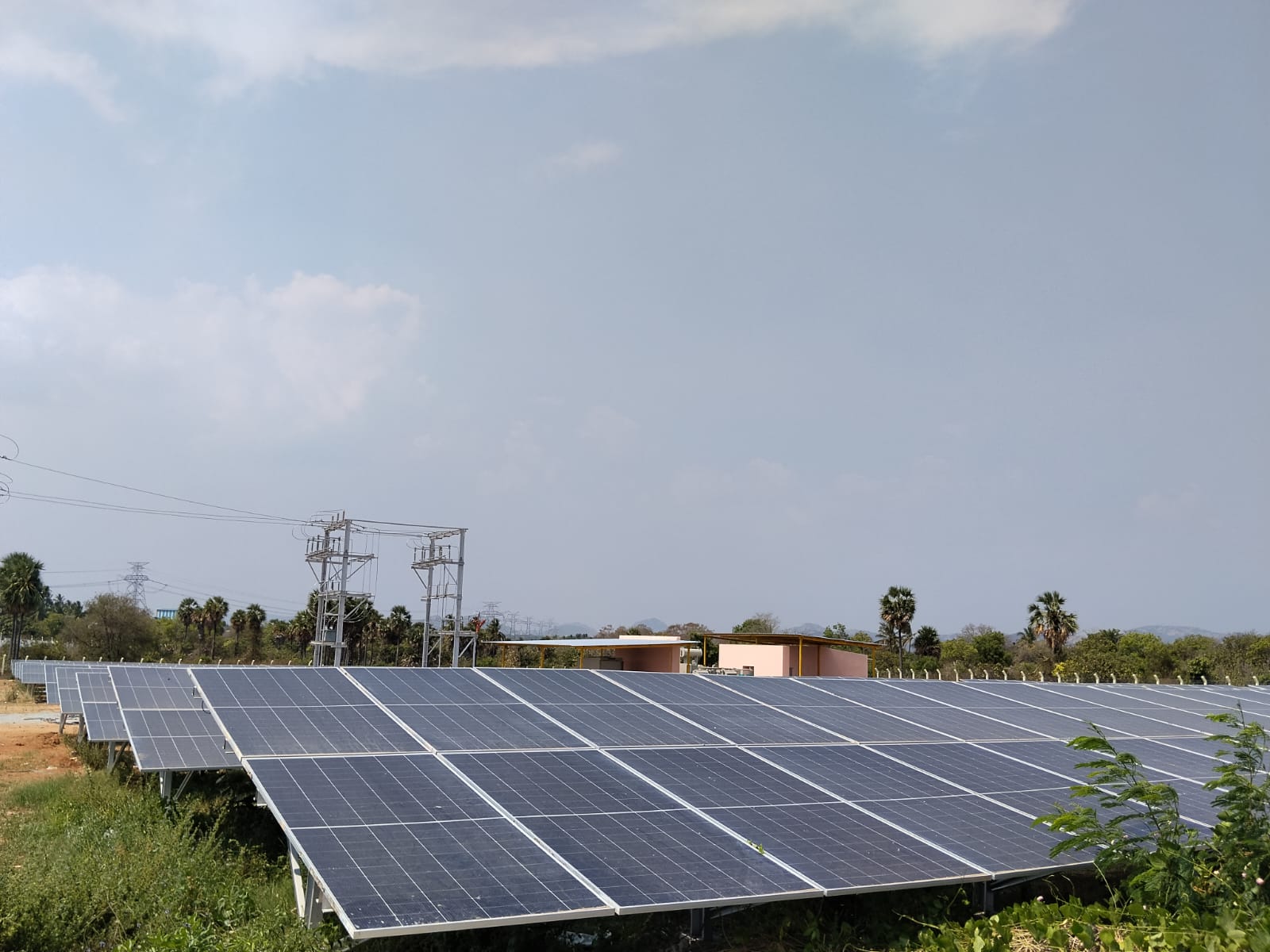
Controller, drive, structure, and stow
A single-axis solar tracker combines mechanical components and a control system to adjust the position of solar panels automatically.
Calculates the appropriate panel position using a programmed solar-position algorithm, sensors, or a combination of control methods.
Motors, gearboxes, or actuators provide the movement required to rotate the tracker.
Supports the solar modules and allows controlled movement along the tracking axis.
Where provided, wind monitoring and stow functions move the structure into a designated protective position during specified weather conditions.
As the sun moves from east to west, the tracker adjusts the panels to improve their exposure to direct sunlight. The actual energy benefit depends on the system design, location, weather, and operating conditions.
Yield, land, and the daily profile
By adjusting panel orientation throughout the day, a tracker can capture more solar energy than a comparable fixed-tilt system under suitable conditions. The actual improvement must be assessed with project-specific solar resource and performance modelling.
For projects with sufficient land and suitable terrain, tracking technology can help increase electricity generation from the installed solar capacity. Row spacing, shading, access, and land characteristics belong in the design.
Tracking can shift more electricity generation towards morning and afternoon periods compared with some fixed-tilt configurations. That may suit a business whose consumption or procurement benefits from a different generation profile.
The additional energy may improve project economics when electricity value and operating conditions justify the extra investment. The assessment should include installation cost, maintenance, financing, energy yield, and equipment downtime.
The gain still depends on the site, the tariff, and how the plant is operated. A fixed-tilt installation can be the better investment where tracking does not add enough value.
Chennai and the rest of Tamil Nadu
Businesses in Chennai and other parts of Tamil Nadu can evaluate solar tracking for suitable ground-mounted commercial and industrial projects. Location alone does not determine whether a tracker is the right investment. Solar tracking is generally more practical for larger ground-mounted projects than for a typical residential rooftop, where space and the extra mechanical cost may outweigh the benefit.
Available land, terrain, and soil conditions decide whether a tracker row can be built and maintained.
Local solar irradiation and weather patterns set the energy the tracker can actually add.
Wind loads and structural engineering requirements shape the foundations and the stow design.
Solar module compatibility and the system configuration have to fit the tracker table.
Maintenance access and project operating costs stay part of the comparison with a fixed mount.
Expected energy generation and investment payback are what decide whether the extra plant is justified.
One axis or two
The primary difference is the number of directions in which the panels can move. The best option depends on the project's energy objectives, site conditions, budget, and lifecycle costs.
| Feature | Single-axis tracker | Dual-axis tracker |
|---|---|---|
| Movement | Rotates around one axis | Moves around two axes |
| Tracking | Primarily follows daily solar movement | Follows daily movement and adjusts for seasonal solar elevation |
| Mechanical complexity | Generally lower | Generally higher |
| Cost and maintenance | Additional cost and maintenance compared with fixed mounting | Typically greater mechanical complexity and cost |
| Common applications | Large ground-mounted solar projects | Specialized projects where additional tracking is justified |
What fixed mounting does not add
Although tracking can improve energy capture, it also introduces considerations that fixed mounting systems do not have.
Mechanical structures, drives, and controls add to project costs.
Moving components require periodic inspection and servicing.
Foundations, wind loads, and site conditions influence design and installation.
Tracker spacing and movement must be planned to manage shading and provide maintenance access.
The additional energy generated may not always offset the additional capital and operating expenses.
A feasibility study can help determine whether a single-axis solar tracker makes financial sense for your installation.
Installed cost against expected yield
The cost of a single-axis solar tracker varies according to project capacity, structural materials, drive systems, control equipment, foundations, installation conditions, and maintenance requirements. Site-specific engineering and integration requirements can also affect the final project cost.
Rather than relying on a generic price estimate, compare the total installed cost with the expected energy yield and long-term operating expenses. This helps establish whether the additional investment is justified for your project.
Since 2013, with 400+ projects
Choosing the right solar technology requires more than comparing equipment prices. Businesses need to consider site suitability, expected generation, structural requirements, and long-term financial performance.
Kyra Photon Tech is the brand to contact to discuss your solar project requirements and identify the appropriate next steps. Before committing to a single-axis solar tracker, evaluate your site conditions and establish whether tracking technology aligns with your operational and investment objectives.
Ready to evaluate solar tracking for a project in Chennai or Tamil Nadu? Call 044-3531-1888.
A single-axis solar tracker uses a drive mechanism and controller to rotate solar panels around one axis, generally following the sun's daily movement from east to west. This helps improve sunlight capture under suitable conditions.
Chennai office
A tracker discussion starts with the land, the planned capacity, the wind and soil, and the generation profile the business actually needs.
Kyra Photon Tech can then discuss whether a single-axis tracker, or a fixed mount, fits that project.
Chennai
Location, planned capacity, and the available land are enough to start. Kyra Photon Tech can discuss a single-axis tracker for a commercial or industrial project in Chennai and Tamil Nadu.