
Solar knowledge
Types of Solar Panels for Industrial Plants: Which Technology Fits Your Roof, Load and Budget
For a factory, warehouse or textile mill, the best panel depends on the roof, the load pattern, the site and the rules the project must follow.
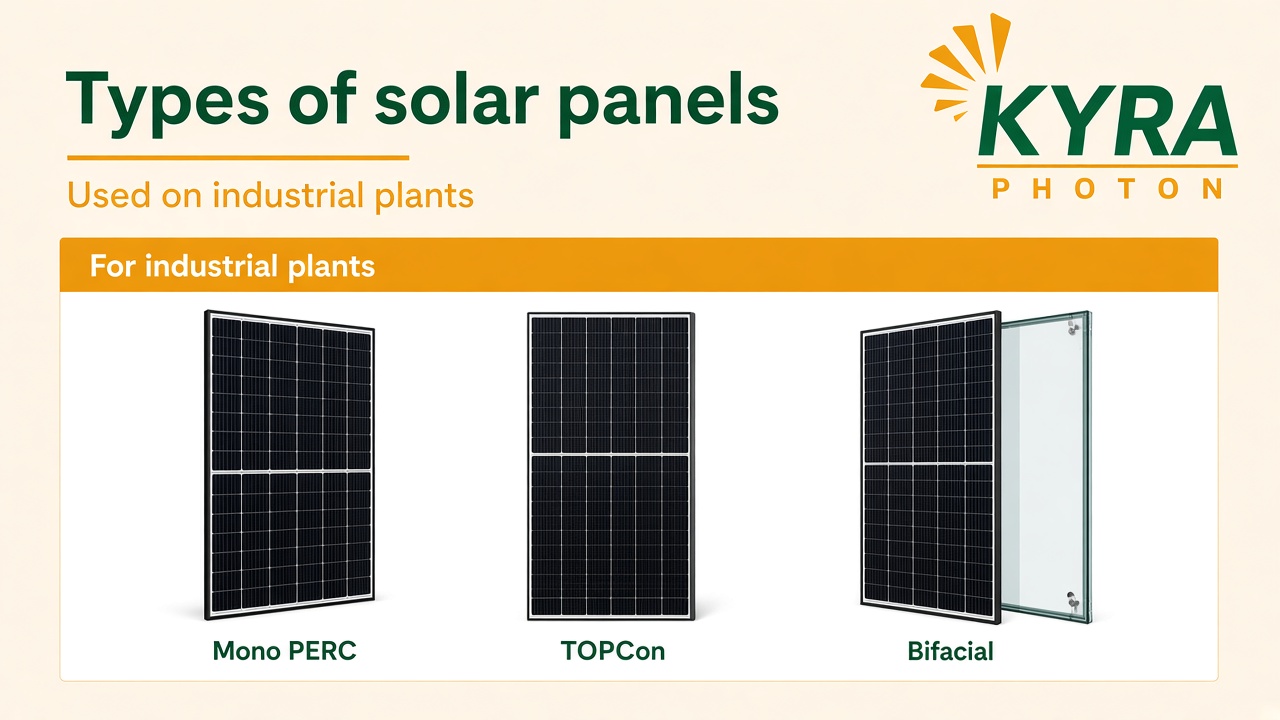 Mono PERC, TOPCon and bifacial modules, the panel types used on industrial plants.
Walk into any solar vendor's office and you will hear the same advice: "this is the best panel." For a home, that may be a simple choice. For a factory, warehouse or textile mill it is not, because the best panel depends on your roof, your load pattern, your site conditions and the rules your project must follow.
This guide covers the panel types you will actually be offered, which ones suit industrial plants, and what to ask before you sign a proposal.
The short version
| Technology | Where it fits | What to watch |
|---|---|---|
| Mono PERC | Established, widely available, strong all-round choice for rooftops | Newer cell designs may offer more output per square metre |
| TOPCon | Increasingly common, aimed at higher output and better behaviour in heat | Check the exact module datasheet, not the technology label |
| Bifacial (glass-glass) | Can add output where the rear side sees reflected light, such as light-coloured flat roofs and ground-mount | Gain depends on mounting height and surface, so it must be modelled, not assumed |
| Polycrystalline | Older technology, now a less common choice for new plants | Lower output per area, so it needs more roof for the same capacity |
| Thin-film | Niche uses such as lightweight or unusual roofs | Lower output per area and limited supply for large plants |
| Perovskite, CPV and other emerging types | Research and pilot stage | Not what a bankable industrial plant is built on today |
What a solar panel actually does
A panel is a set of cells that convert sunlight into direct current. Inside each cell, a junction pushes the freed electrons one way, which creates the current. The inverter then converts that DC into the AC your plant uses. The panel is only one part of the system, which is why it should never be chosen in isolation from the inverter, the structure and your load.
The panel types explained
Mono PERC
Monocrystalline cells with a passivated emitter and rear cell design, a rear layer that reflects light back into the cell and reduces losses. It has been the workhorse of recent years and is still the largest slice of India's listed cell manufacturing capacity, at roughly 52% according to a Saur Energy analysis of the ALMM cell list (September 2026).
TOPCon
Tunnel oxide passivated contact cells use a different rear structure designed to cut recombination losses further. The same analysis puts TOPCon at about 33% of India's listed cell capacity, which shows how quickly it is gaining ground. For plants, the usual argument is higher output per module and better performance at high temperatures, both of which matter in Tamil Nadu's climate. Verify the actual temperature coefficient and degradation figures on the datasheet.
Bifacial modules
Bifacial modules collect light on both faces. On a light-coloured flat roof or a ground-mount array with enough clearance, the rear side can contribute meaningful extra energy. On a roof where panels sit flush against a dark surface, there is almost nothing to gain. The right way to decide is a yield simulation for your specific layout, not a rule of thumb.
Polycrystalline and thin-film
These remain in the market, but for new industrial plants the main limitation is output per unit of area. If roof space is the constraint, which it often is on factory sheds, higher-output monocrystalline designs generally make more sense.
Emerging technologies
Perovskite, concentrated PV and organic cells make headlines. They are not what a plant you will rely on for 25 years should be built on today.
Choosing for a plant, not for a catalogue
Ask these questions of any proposed module:
- Is it on the approved list that applies to your project? India's ALMM rules govern which manufacturers' modules, and increasingly cells, can be used. A Sagus Legal note from June 2026 reports that the cell-sourcing requirement applies to net-metering and open-access projects commissioned on or after 1 June 2026, subject to case-by-case extensions. Confirm how that applies to your project before you rely on it.
- What is the performance warranty? Look at first-year degradation, annual degradation and the guaranteed output at year 25 or longer.
- How does it behave in heat? Tamil Nadu rooftops run hot. The temperature coefficient on the datasheet tells you how much output you lose.
- How does it handle dust and humidity? Look at frame, glass and encapsulation quality, and plan cleaning into your maintenance.
- Does it fit your structure? Larger, heavier modules affect roof loading, handling on site and mounting design.
- Is it matched to the inverter? Module voltage and current must suit the inverter's input window across the temperature range.
- Who stands behind it? A manufacturer's warranty is only as good as the manufacturer's ability to honour it years from now.
Same panel, different plant
Textile and spinning mills, packaging units
Large shed roofs, often multiple shifts, and hot conditions. Output per area, temperature behaviour and structure design matter most. Our rooftop work includes Polyspin Exports Limited at 1.3 MWp and Chola Packaging at 959 kWp in Rajapalayam, and Artika Cotton Mills (Ramraj) at 821 kWp in Erode.
Large ground-mount plants
Land and evacuation shape the design, and bifacial modules and tracking choices become real options. Our ground-mount work includes Suvarrchit Renewable Energy at 13 MWp in Tiruvannamalai and Koochur Solar Park at 7.8 MWp in Krishnagiri.
Sites with limited roof area
Here higher-output modules can let you reach your target capacity within the space you have.
How Kyra picks the panel
We do not start with a brand. We start with an Energy Study of your bills and load, a Site Survey of your roof or land, and Engineering that models yield for your layout. Module choice follows from that work, along with approvals, installation, commissioning, monitoring and maintenance.
Since 2013, Kyra Photon has delivered end-to-end renewable energy solutions for commercial and industrial businesses, with 400+ projects commissioned across India.
Not sure which panel suits your plant?
Share your roof details and 12 months of bills, and our engineers will study your site and recommend a technology based on how your plant actually runs. Email info@kyraphoton.com or call 044-3531-1888.
FAQs
Which solar panel type is best for a factory?
There is no single winner. Mono PERC and TOPCon are the main choices for new industrial plants, and the better fit depends on your roof area, climate, applicable rules and budget.
Are bifacial panels worth it for rooftops?
Only where the layout lets the rear side receive reflected light. A yield simulation for your roof should decide, not the label.
Do panel types affect payback?
Yes, through output per area, degradation, price and warranty. Compare modules on lifetime generation, not just the price per watt.
What does ALMM mean for my project?
It is the Government of India approved list of manufacturers for solar modules and cells. Whether it applies, and to what, depends on your project category and commissioning date, so confirm it at the proposal stage.
What does PERC stand for?
Passivated Emitter and Rear Cell.