
Solar knowledge
What Does an Industrial Solar Plant Really Cost? The Factors That Decide Price and Payback
The price per kW is the least useful part of any quote. For a plant head or CFO, the number that matters is what each unit of solar power costs over the next 25 years, compared with the grid.
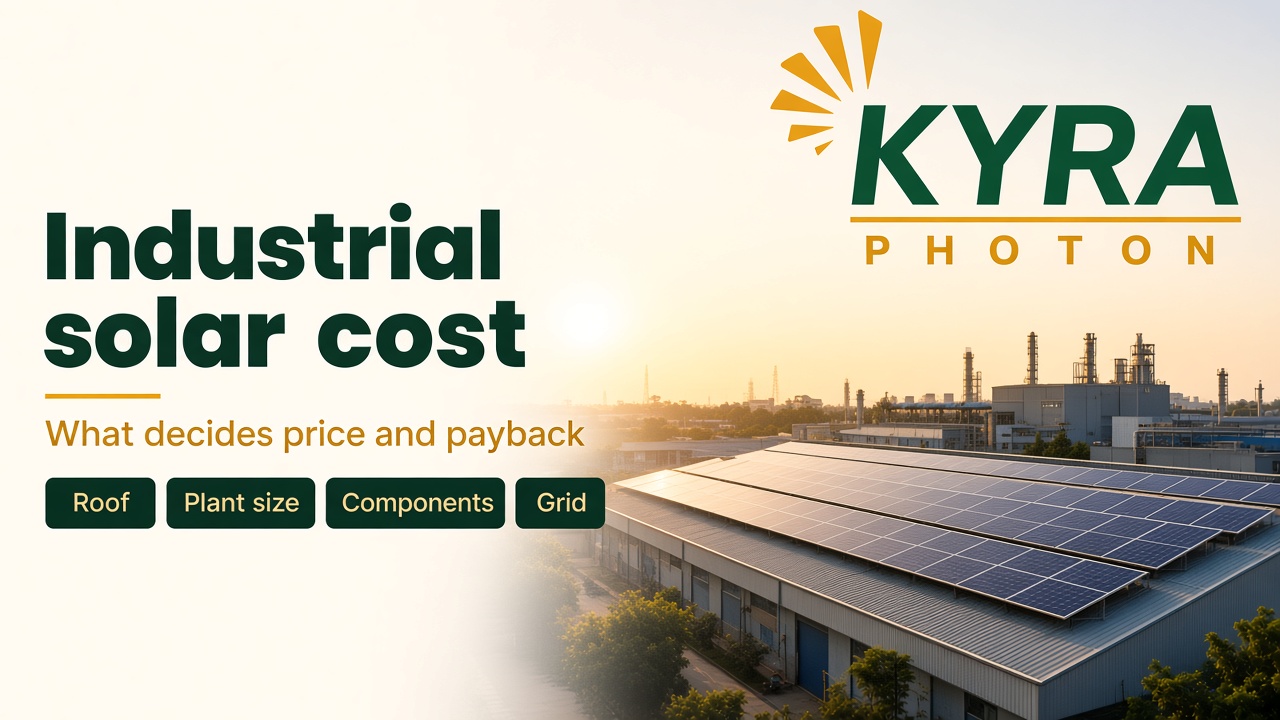 Price follows the site, the scope and the commercial model. A flat rate before a survey is a guess.
Ask three solar companies what a factory rooftop plant costs and you will get three different numbers. All three can be honest. The price per kW is the least useful part of any quote, because two plants with the same headline rate can have very different scope, quality and lifetime returns.
For a plant head or CFO, the number that matters is not what the system costs on day one. It is what each unit of solar power costs you over the next 25 years, compared with what you pay the grid. This guide breaks down what goes into the price, what moves it, and how to compare proposals fairly.
The short answer
| What decides the price | Why it matters |
|---|---|
| Roof or land condition | RCC roofs, metal sheet roofs and open land need different structures and civil work |
| Plant size | Larger plants spread fixed costs across more capacity |
| Component quality | Module and inverter make, warranty terms and efficiency affect both price and output |
| Grid connection | Distance to the substation, transformer and switchgear needs, and evacuation work |
| Approvals | Permissions and utility formalities add scope, and time |
| Commercial model | CAPEX, RESCO/OPEX and Open Access change who pays what, and when |
Rooftop, ground-mount or open access: cost behaves differently
Rooftop solar uses space you already own, so there is no land cost. Price depends on roof type, height, shading and structure strength. Our rooftop projects span Polyspin Exports Limited at 1.3 MWp and Chola Packaging at 959 kWp in Rajapalayam, and Artika Cotton Mills (Ramraj) at 821 kWp in Erode.
Ground-mounted solar suits plants with spare land or larger power needs. Cost shifts toward land preparation, structures, cabling and evacuation. Our ground-mount work includes Suvarrchit Renewable Energy at 13 MWp in Tiruvannamalai, Sivagangai Solar Park at 12 MWp and Koochur Solar Park at 7.8 MWp in Krishnagiri.
Open Access delivers renewable energy to your plant from a project located elsewhere. It suits businesses whose roofs cannot cover their demand, and the cost story depends on how units are delivered and charged rather than on a plant on your premises.
What is actually inside the price
A solar proposal is not just panels. A complete industrial plant includes:
- Solar modules: usually the largest single line item
- Inverters: convert DC from the panels to AC for your plant
- Mounting structures: matched to your roof or land and local wind conditions
- Balance of system: cables, protection devices, earthing and lightning protection
- Monitoring: so you can see generation and spot faults early
- Civil and electrical interconnection: panels, switchgear and transformer connections to your system
- Engineering, approvals and commissioning
Cheaper quotes often leave out something from this list. Always check what is in scope.
Six things that quietly move your solar cost
- Site conditions: shading, roof strength, orientation and available area
- Electrical layout: where the plant connects and how far power travels
- Component choices: efficiency, warranty and expected degradation over time
- Design for your load: a plant sized to your daytime consumption performs differently from one sized to the roof
- Approvals and timelines: utility formalities vary by consumer category and location
- After-sales commitments: monitoring, maintenance scope and response time
Why the commercial model changes your real cost
CAPEX
You invest, you own the plant, and the savings accrue to you. Your cost is the project price, less any tax benefits.
RESCO / OPEX
You pay only for the power you consume, with no upfront investment. Your cost is the per-unit rate.
Open Access
You buy renewable power from a project beyond your premises, with charges that depend on delivery and regulation.
The cheapest option on paper is not always the best fit for your balance sheet. A plant with strong cash flow may prefer to own. One that wants to keep capital for operations may prefer to pay per unit.
Tax and incentive layers for businesses
Businesses sit under different rules from homeowners.
- Subsidies: Rooftop subsidies advertised to households generally are not designed for commercial and industrial plants.
- Depreciation: Under the Income-tax Act, solar power generating systems have been eligible for accelerated depreciation, reported at 40% on written down value, with an additional first-year allowance for qualifying businesses.
- GST: Rates apply to modules, inverters and installation works.
How to compare solar quotes properly
Put every proposal on the same footing before comparing price:
- Is the capacity in kWp (panels) or inverter kW?
- Which module and inverter makes, and what warranty on each?
- What annual generation is promised, and on what assumptions?
- Is civil work, cabling, earthing and transformer interconnection included?
- Are approvals included, and who handles utility paperwork?
- What does O&M cover, and for how long?
- Is monitoring included?
Then compare payback on your own numbers:
Payback (years) = Net project cost ÷ Annual savings
Annual savings ≈ Annual generation (kWh) × Grid tariff you offset (Rs per kWh) − Annual O&M cost
Remember that panel output declines slowly over the years, so a fair model accounts for degradation.
How Kyra keeps the number honest
Our process starts with an Energy Study and Site Survey, so pricing follows your bills and your site, not a template. Then comes Engineering, Approvals, Installation, Commissioning, Monitoring and Maintenance, all managed by one team.
Since 2013, Kyra Photon has delivered end-to-end renewable energy solutions for commercial and industrial businesses, with 400+ projects commissioned across India.
Want a cost estimate built on your numbers?
Share 12 months of bills and your site details, and our team will study your load and show you what solar can realistically do for your plant. Email info@kyraphoton.com or call 044-3531-1888.
FAQs
What is the cost of an industrial solar plant in India?
It depends on plant size, site, components, grid connection and commercial model. A fair estimate needs your bills and a site survey.
Is CAPEX or RESCO better for a factory?
CAPEX gives ownership and the full savings. RESCO avoids upfront investment and charges per unit consumed. The better choice depends on your cash position and priorities.
Do home solar subsidies apply to industries?
Generally, household subsidy schemes are meant for residential consumers. Confirm current eligibility for your category.
How long does it take to recover the investment?
It depends on tariff, generation, consumption pattern, model and tax treatment. Use the payback formula with real numbers from your own proposal.
What should a good proposal include?
Clear capacity (kWp and inverter kW), component makes and warranties, expected generation with assumptions, full scope of civil and electrical work, approvals, O&M and monitoring.