
Solar knowledge
kW, kWh and kVA Explained: What Every Factory Owner Should Know Before Going Solar
The gap between a machine’s nameplate and its energy bill is the difference between kW and kWh. Get it right, and your bill, your solar sizing and your savings case start to make sense.
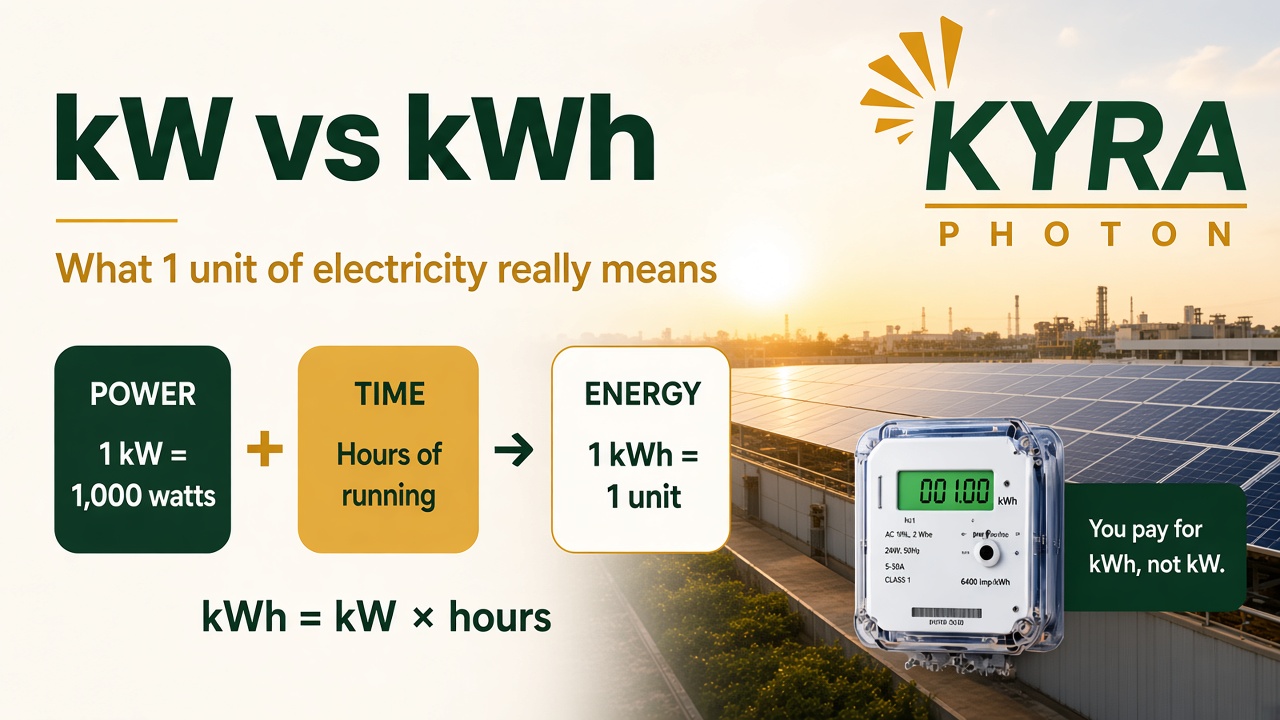 Power over time becomes energy. A factory pays for units (kWh), not the kW on a nameplate.
Here is a puzzle plant heads run into every month. A 75 kW compressor that runs for half an hour adds about 37.5 units to your bill. A 5 kW lighting and utility load that never switches off adds 120 units in a single day. The big machine looks scarier on the nameplate. The small one quietly costs more.
The short version
| Term | What it measures | Think of it as | Where you see it |
|---|---|---|---|
| kW | Power at a moment | How hard the plant is drawing right now | Motor and machine ratings, sanctioned load |
| kWh | Energy over time | Total consumed (1 kWh = 1 unit) | Energy line on your bill |
| kVA | Apparent power | The capacity your supply must carry | Transformers, DG sets, demand on HT bills |
| kWp | Peak solar panel capacity | What the panels can deliver in ideal conditions | Solar proposals and project sizes |
Picture a tap and a tank. The tap’s opening is kW: how fast energy is flowing at this instant. The water collected in the tank is kWh: how much has actually been used once time is counted in.
Energy (kWh) = Power (kW) × Time (hours)
This is why a unit is not a fixed amount of anything on its own. A unit of electricity is one kWh, and you only get there when a load runs for a period of time.
One hundred units, three different ways
The same energy can come from very different loads:
- A 100 kW load running for 1 hour
- A 25 kW load running for 4 hours
- A 5 kW load running for 20 hours
All three add exactly 100 units to your bill. For a plant that runs multiple shifts, this is the point that matters most: run-time often decides your bill more than machine size does. It is also why solar suits industries with long daytime operating hours so well.
Quick conversions worth remembering
- Watts to kW: divide by 1,000
- kW to kWh: multiply by hours of running
- kWh to units: they are the same number
A 22 kW motor running 8 hours a day uses 176 kWh, or 176 units, that day.
Why a factory bill is more than just kWh
Home bills are mostly about units. Industrial bills usually carry more layers:
- Demand (kVA or kW): the highest draw recorded in the billing period, which can attract its own charge.
- Power factor: the gap between kW (useful power) and kVA (total supply capacity). A low power factor means your supply infrastructure carries more than your machines actually use.
- Time-of-day rates: the same unit can cost differently at different hours.
kW, kWp and inverter kW: the solar detail most people miss
Solar proposals add one more term. kWp is the peak DC capacity of the panels. The inverter has its own AC rating in kW. They are often close, but they are not identical, and the difference affects real energy output.
This is why our projects are quoted in peak capacity: Polyspin Exports Limited at 1.3 MWp and Chola Packaging at 959 kWp in Rajapalayam, Artika Cotton Mills (Ramraj) at 821 kWp in Erode, and ground-mount parks such as Suvarrchit Renewable Energy at 13 MWp in Tiruvannamalai. When you compare quotes, check whether the number is kWp or inverter kW, and compare like for like.
How solar is sized for a plant: the actual method
A “5 MW plant” is not a sizing method. A sound one works like this:
- Start with your consumption: monthly kWh from at least 12 months of bills, so seasonal swings show up.
- Understand your load profile: when you draw power through the day, since solar generates in daylight hours.
- Check the roof or land: usable area, shading, structure strength and orientation.
- Apply realistic site yield. Annual generation (kWh) is about the system size in kWp multiplied by the site yield in kWh per kWp per year. That yield depends on the site, and it should be confirmed for that location before the size is locked.
- Match size to goal: cover a share of daytime load, maximise savings, or meet a sustainability target.
This is exactly why our process begins with an Energy Study and a Site Survey before Engineering starts, and continues through approvals, installation, commissioning, monitoring and maintenance.
How your commercial model changes the numbers you watch
CAPEX (you own the plant)
You track generation in kWh and the savings it creates against your bill.
RESCO / OPEX
You pay only for the power you consume, so the kWh rate and your consumption are the numbers that matter.
Open Access
Renewable energy delivered beyond your premises, where units delivered and how they are accounted for matter most.
Choosing between them is a finance and operations decision as much as an engineering one, which is why we look at all three with you.
Why plants work with Kyra Photon
Since 2013, Kyra Photon has delivered end-to-end renewable energy solutions for commercial and industrial businesses, with 400+ projects commissioned across India. Our approach is engineering-driven: we read your bills, study your load, and design around how your plant actually runs.
Not sure what your bill is really telling you?
Share a few months of bills with our team and we will walk you through your load, your units and what solar could realistically do for your plant. Email info@kyraphoton.com or call 044-3531-1888.
FAQs
Is 1 kW the same as 1 unit?
No. 1 kW is a rate of power. 1 unit is 1 kWh, which is 1 kW sustained for one hour.
How do I calculate units used by a machine?
Multiply its running power in kW by the hours it runs. A 10 kW machine running 6 hours uses 60 units.
What is the difference between kW and kVA?
kW is the useful power doing work. kVA is the total capacity the supply must handle. The ratio between them is your power factor.
Why does my solar proposal say kWp and not kW?
kWp is the panels' peak DC capacity under standard test conditions. Actual AC output also depends on the inverter and site conditions.